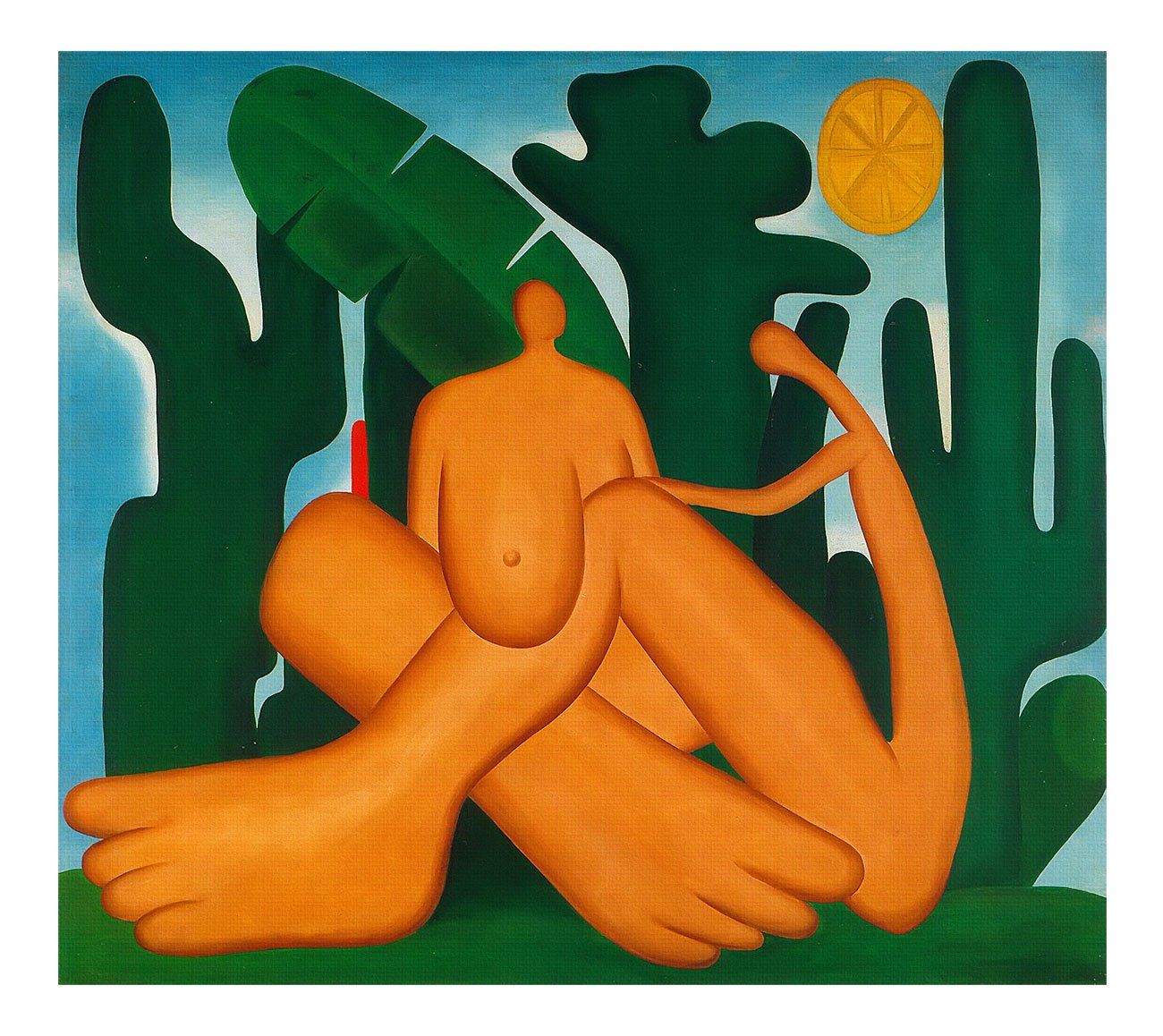
Title: Anthropophagy
Artist: Tarsila do Amaral
Place of Origin: Brazil
Date: 1929
Dimensions: 49 3/5” x 55 9/10”
Materials: oil on canvas
Amaral’s work inspired the Brazilian modernist art movement, initially described by her husband Oswald de Andrade in his revolutionary essay, “The Cannibalist Manifesto.” Anthropophagy, literally meaning “cannibalism,” is an example of a movement that involved Brazilian artists absorbing, or cannibalizing, artistic techniques, styles, and ideas from all sources; foreign or native, ancient or modern, popular or obscure. Maria Castro of Smarthistory writes, “After a process of digestion, or synthesis, this consumption would yield new cultural products, both original and genuinely Brazilian.” One idea commonly cannibalized in a lot of modern, surrealist art was Freud’s conception of the battle between the id (base instinct, sensuality) and the superego (logic, rules, society) that exists in all people. In the early 20th century, these ideas were applied to non-European cultures and many thought “natives” were more in-tune to nature and instinct. Amaral reflects these ideas intentionally in her abstracted portraits of indigenous Brazilians, who she depicts with enlarged feet, breasts, and bodies with small heads. As she was not a part of the ethnic groups she portrayed, it may be asked on what authority she could make this commentary in her art. Amaral joins a long tradition of European artists portraying the cultures of the rest of the world, often in inaccurate and degrading ways.
https://arthistoryproject.com/artists/tarsila-do-amaral/anthropophagy/
Maria Castro, “Tarsila do Amaral, Abaporú,” Smarthistory, January 11, 2018, https://smarthistory.org/tarsila-abaporu/.

 Conversation