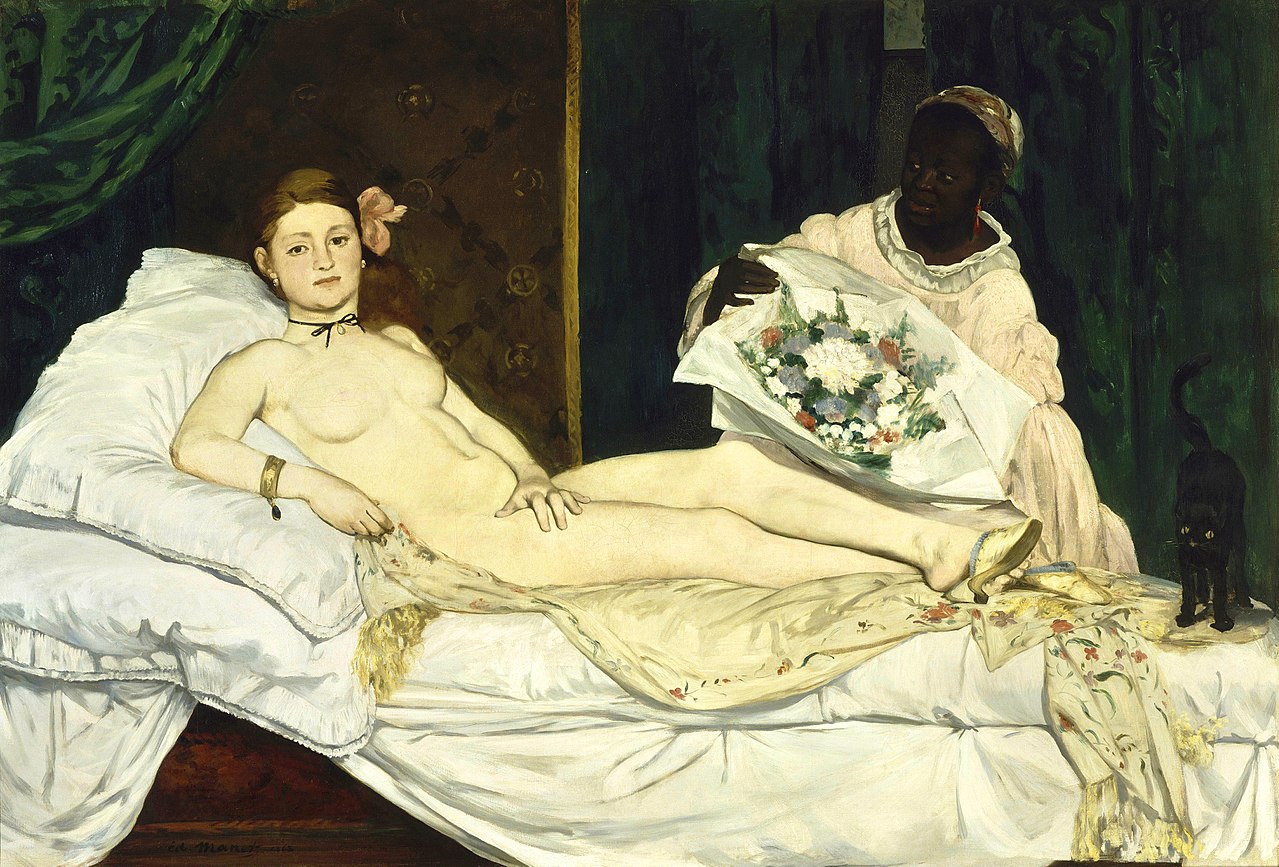
Title: Olympia
Artist: Édouard Manet
Place of Origin: France
Date: 1863
Dimensions: 51 9/10” x 74 8/10”
Materials: oil on canvas
Insulted and criticized when first released, Olympia challenges assumptions about what makes fine art and what our motivations are for wanting to look at certain imagery. While drawing on the visual vocabulary of the classical, idealized woman, she is shorter than the traditional nude. Her face is asymmetrical, and her eyes, instead of turned away, flirty, or coy, are direct and intelligent. Her body is not rendered in the traditional manner; brush strokes are visible as if to remind us that what we are looking at is only paint and not a real woman. Her hands are the most detailed part of her body aside from her face. One hand, while in the traditional position of covering her genitals, seems to block. She is stern, closed off. Manet, a male artist, seems to be questioning why women are always portrayed a certain way in art. This painting reminds the viewer that the tradition of the female nude, far from being about the purity of form as art scholars have long claimed, has an inherently sexual motive. Most traditional nude paintings are made by men of beautiful women who are idealized, sometimes to the point of impossibility. Like Amaral’s pieces, those depicted are subject to the ideas and opinions of a disinterested group with power looking in on them. Olympia asks us to question why men portray women this way, and on what authority they do so.
Dr. Tom Folland, “Édouard Manet, Olympia,” Smarthistory, December 9, 2015, https://smarthistory.org/edouard-manet-olympia/.

 Conversation